Energy Drinks |
In the past five years energy drinks have exploded onto the market. Why? The obvious answer is the quick boost one gets from this ergogenic aid (a substance or technique that improves physical performance. Caffeine is an effective ergogenic aid, particularly for athletic events that involve endurance. Caffeine has been shown to increase the use of fat as an energy substrate, thereby sparing glucose). Not only for physical performance but I believe for appearance also. I think there are many that use these as a dietary supplement which can be dangerous due to lack of many vitamins and minerals, and excess of sugar.
Most energy drinks are made up of the same ingredients. One ingredient
they all have in common is a form of sugar such as sucrose (table sugar)
or glucose. Typically, the drinks with more sugar give the quicker rush,
but also have the horrible letdown, and last a shorter amount of time. Many
also include a range of vitamins (especially B group vitamins). Some
have amino acids (e.g. 'taurine') while herbal supplements such as Gingko
biloba, Echinacea, Ginseng and St John's Wort are present in many. They
also usually include guarana (a caffeine-containing extract from a South
American plant). The typical energy drink provides about 80 mg
of caffeine per can. This is about the same as the amount of caffeine
provided by an average strength cup of coffee, and about twice that in
a cup of tea. It is also about twice the level of caffeine found in a
can of carbonated, cola-flavored soft drink.
Thus, begins the first problem I have. Many parents would not allow
their young children to drink coffee or strong tea, because they know
that these drinks contain caffeine, the same may not apply to energy
drinks. This may be at least partly because the quantity of caffeine
isn't always stated on the label of energy drinks, and many people aren't
aware of how much caffeine constitutes 'high-caffeine' anyway. Many children
could have disturbed sleeping patterns, suffer bed-wetting and show symptoms
of anxiety from ingesting the caffeine in just one can of energy drink,
and anybody with heart disease should avoid large intakes of caffeine.
The sudden 'jolt' to metabolism caused by caffeine (which is a stimulant)
can be enough to trigger a heart attack in people with pre-existing heart
conditions. Finally, a new trend of mixing energy drinks and alcohol
can very dangerous, let alone deadly.
Overall, I believe that lo-carb energy drinks can help play a vital role
with sports, fat-loss, weight training, etc., but as I always say, “Moderation
is Key.” The old adage that more is better isn’t always
true. For myself, I am a big believer in Spark which has no sugar
and gives hours of energy with no jitters or letdown, compared to others
on the market it offers more bang for the buck.
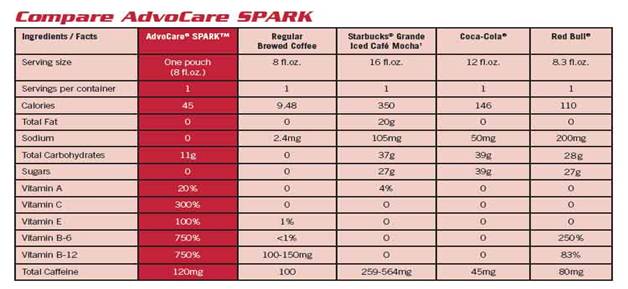
Cost 1.00-1.40 1.00 3.50-4.00 .40-.50 2.00
…For more information and tips, check my website, www.chadamartin.com and thanks to Advocare for providing supplements.
|
||
|

